Category: Books

  • “Writing Fiction in Turbulent Times”

    “Writing Fiction in Turbulent Times”

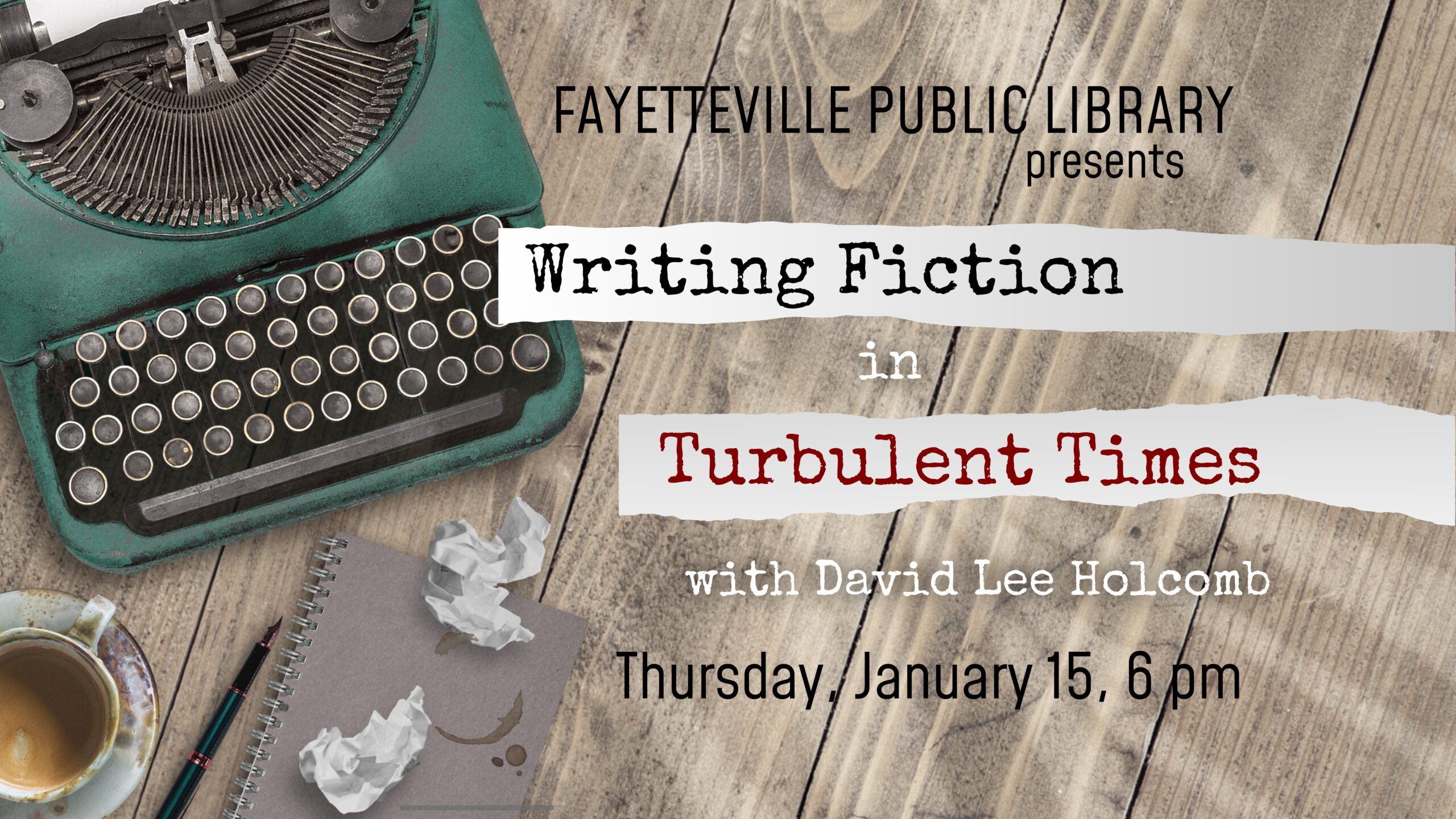
    Title graphic for a writing lecture by David Lee Holcomb entitled "Fiction Writing in Turbulent Times."

    Join me on Thursday, January 15, at 6 pm at the Fayetteville Public Library for an evening of conversation and entertainment.

    This will be a bit different from my previous outings at Pearl’s Books, the West Fork Public Library, the NWA Book Fest, and so on. This time, I won’t just be talking about my latest book (although there’ll be some of that), but I’ll be going into the whole process of creating a work of fiction from nothing but a truckload of words and the desire to tell a story. I’ll draw on my own experience while also bringing in observations and advice from great writers and artists.

    We’ll go through several questions together. For instance:

    • Why write novels when the whole damn world is on fire?
    • Why should anybody listen to anything I’ve got to say about writing?
    • Where does your novel start? Where does it end?
    • How does a story get from “Once upon a time…” all the way to “…and they lived happily ever after,” without ending up in a ditch somewhere?
    • Are there any rules for writing a book, and if so, what are they, and who got to make them up?
    • Is it crazy to start writing when your life is already half over?

    This event is free and open to the public.

    Come out and enjoy the warmth and comfort of the Walker Community Room at the Fayetteville Public Library with me.

    At the very least I can promise to be entertaining and energetic . . . and maybe something I tell you will trigger that creative spark you’ve been keeping hidden all this time!

  • Audio: Local Author Open House!

    A clip from an interview with our local public radio station to promote an author event.

  • Proof of life…

    Proof of life…

    Sales on my first fantasy novel, Strange News, are going reasonably well — knock wood! In terms of costs, I may be on track to break even on this one by this time next year, at which point I hope to have a new book ready to hit the streets.

    As for that work-in-progress, I’m halfway through the first draft, coming up on what the writing expert YouTubers call the “midpoint reversal.” The middle of every book is a bloody mess to write, and this one is no exception, but I think (I hope!) I’ve learned a few things by now. I’m moving a little more smoothly than usual through this difficult stretch. Thoughts and prayers, everybody.

    The upcoming book will be titled Apocryphon, and it dips into the fantasy genre a little more deeply than Strange News. Still no dragons or swords or incestuous royal families slaughtering each other at weddings, but most of the story takes place on an alternate Earth where something that might be called magic is common. Get ready to pay a visit to Palliset, the City at the Center of Time:

    As long as you have the necessary time banked up, any westbound train will take you from Boston or Bengaluru or Beijing to the Grand Plaza Station, but no earthly airship has ever looked down on Palliset’s dusty sprawl, and no Pallisene explorer has ever found the slightest trace of a superhighway or a McDonald’s, no matter how far from the plateau they’ve traveled. Palliset is an island of civilization in an otherwise empty world of endless scrub desert and shortgrass prairie at the other end of a train ride from anywhere on Earth.

    A paradox. A whole city of paradoxes. The center of all things, the Book of Secrets called it. Is this magic? It’s certainly not logical, not reasonable. It’s a place Mac might have invented just to fluster me, to make me laugh. Maybe that’s all magic ever is.

    In Palliset, nobody cares about the contradictions. They’ve always been here. They’ve always been who they are. They expect to be here until the end of time.

    But then, don’t we all?

    — From Apocryphon: Bishop Berkeley’s Book of Secrets, by David Lee Holcomb. Coming in 2026.

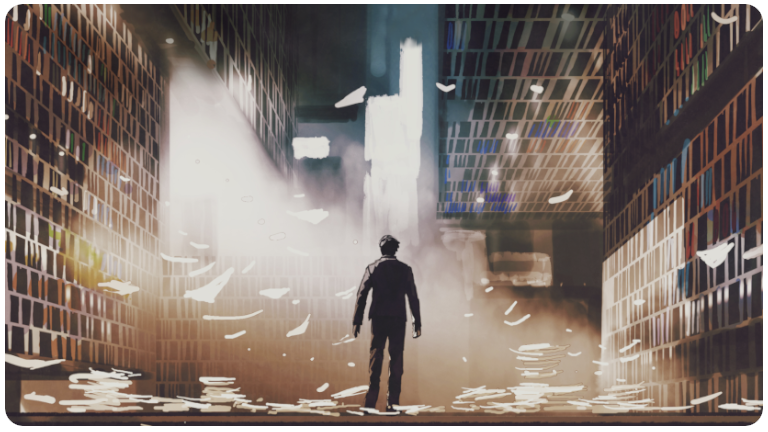
    A man stands in the midst of a library. Books and papers fly around him.
  • Fiction: “The Woman At Front Two”

    Fiction: “The Woman At Front Two”

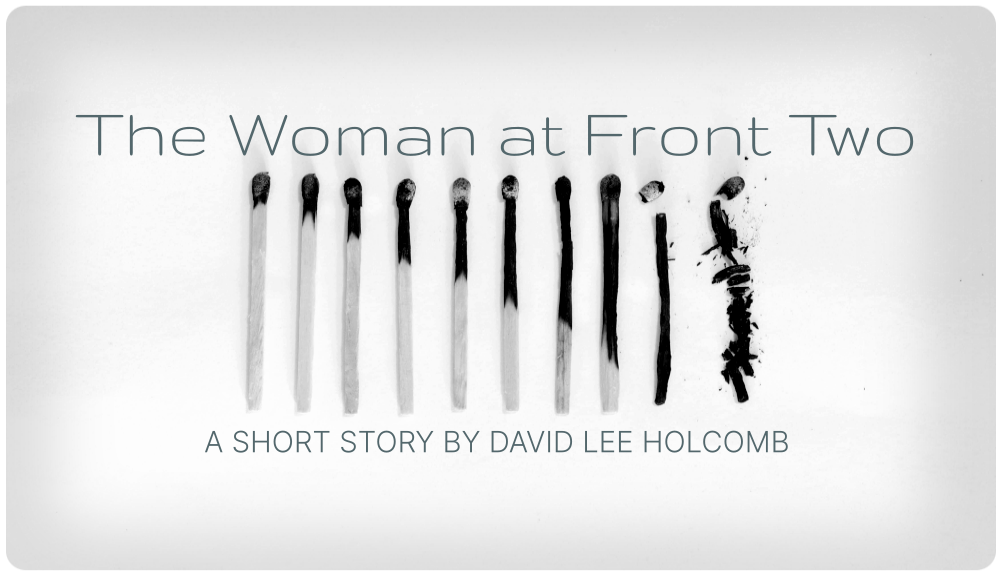
    Image of burned-out matches.

    The woman at table Front Two does not look happy.

    This seems wildly unfair, given that she is drop-dead gorgeous and reeks of money. I am at a stage in my life where I’m sure having a hot body and a little extra cash would solve all my problems, with some self-esteem left over to share with friends and acquaintances. The woman in the caramel-colored suit and white silk blouse should be lighting up that end of the room; instead, she’s generating her own gravity, pulling the light down into herself and smothering it.

    Maybe she just needs a nice slice of cheesecake.

    “More coffee?”

    “Please.”

    I top up her cup and stand back. “Anything else I can do for you?”

    She takes a sip. I admire her bracelet, a chunky thing made of grayish-blue stones the color of a fresh bruise. She looks up at me, and I see that her eyes are the same color.

    “I think that’s highly unlikely, don’t you?” she says.

    (more…)
  • Good, gooder, goodest.

    Good, gooder, goodest.

    image of French philosopher Voltaire

    Way back in 1770 the French philosopher, historian, and poet Voltaire wrote that “Perfect is the Enemy of Good.”1 He was quoting an Italian proverb, which was itself probably derived from the Greeks or the Etruscans or somebody, but we’ll go with Voltaire because he said so many wonderful things and deserves all the credit he can get.

    This statement, “Perfect is the Enemy of Good,” seems troubling at first glance. Shouldn’t we strive for perfection, even if we know that we — flawed beasts that we are — can never achieve it? According to yet another poet, Robert Browning, “…a man’s reach should exceed his grasp.”2

    (more…)
  • Elaine, let’s get the hell out of here.

    Elaine, let’s get the hell out of here.

    Photograph of an old-fashioned library card catalog, with many small filing drawers

    I don’t like country music. The yodeling vocals, the whining guitars, the relentlessly predictable lyrics about faithless babes, abusive bubbas, pickup trucks, disreputable nightspots in the middle of nowhere … An hour of this, and a visitor from another planet would marvel that everything south of the Mason-Dixon line had not long since slid off into the Gulf of Mexico, crushed into slurry under the weight of all that drama and all those tears.

    “Wait just a gosh-darned minute!” I hear someone shouting from the back row. “Yes, a lot of country music is like that, but it’s not all the same. You’re being unfair.”

    (more…)
  • Truth and lies.

    I was poking around among the bookshelves a day or so ago, looking for something to entertain me as the first cool weather of the season settles in, when I spotted my rather tattered Penguin Classics copy of the Histories of Herodotus.

    (more…)
  • The shape of words.

    Anyone who knows me may be surprised to learn that I own three Bibles (the Revised Standard, the New English, and the King James), as well as the Book of Mormon, the Nag Hammadi Scriptures, the Apocrypha, and an English translation of the Qur’an. I know the difference between an Apostle and an Epistle, I can list the twelve sons of Jacob*, and I can whip out a quote from the four Gospels for just about any occasion.

    (more…)
  • Bam. Pow. Kablooie.

    Anguish. Antagonist. Annihilate. Adept.

    What do all these words have in common?

    Venerable. Veritable. Volcanic. Variable.

    I’ll give you a hint: I had learned to use all of them in a sentence by the time I reached the third grade.

    (more…)
  • On Aging

    From “Mathios Paschalis among the Roses”, by George Seferis:

    Her aunt was a poor old body, — veins in relief,
    Many wrinkles about her ears, a nose about to die;
    Yet her words always full of wisdom.
    One day I saw her touching Antigone’s breast,
    Like a child stealing an apple

    Will I perhaps meet the old woman as I keep descending?
    When I left she said to me “Who knows when we shall meet again?”
    Then I read of her death in some old newspapers
    And of Antigone’s wedding and the wedding of Antigone’s daughter
    Without an end of the steps or of my tobacco
    Which imparts to me the taste of a haunted ship
    With a mermaid crucified, when still beautiful, to the wheel.

    (Excerpted from “George Seferis: Poems”, translated from the Greek by Rex Warner, Nonpareil Books, 1960)